6 Days in Tuscany with Kids from a San Gimignano Base
Tuscany works well with kids. The problem is how most families plan it. Multiple hotels, packed itineraries, and daily repacking create friction that turns a good trip into an exhausting one.
The approach that works better: one fixed base near San Gimignano, a car, and one day trip per day. Six days. No moving hotels. Enough variety to feel like a real trip, enough stillness to feel like a vacation.
At a Glance: The 6-Day Itinerary Overview
| Day | Primary Destination | Approx. Drive from San Gimignano | Pace Rating |
|---|---|---|---|
| 1 | San Gimignano (on foot) | 0 min | Easy |
| 2 | Volterra | ~40-50 min | Moderate |
| 3 | Siena | ~45-60 min | Demanding |
| 4 | Rest day (agriturismo + countryside) | 0 min | Easy |
| 5 | Certaldo Alto + Monteriggioni | ~20-25 min / ~35-40 min | Moderate |
| 6 | Chianti countryside (Greve in Chianti) | 70 min | Easy |
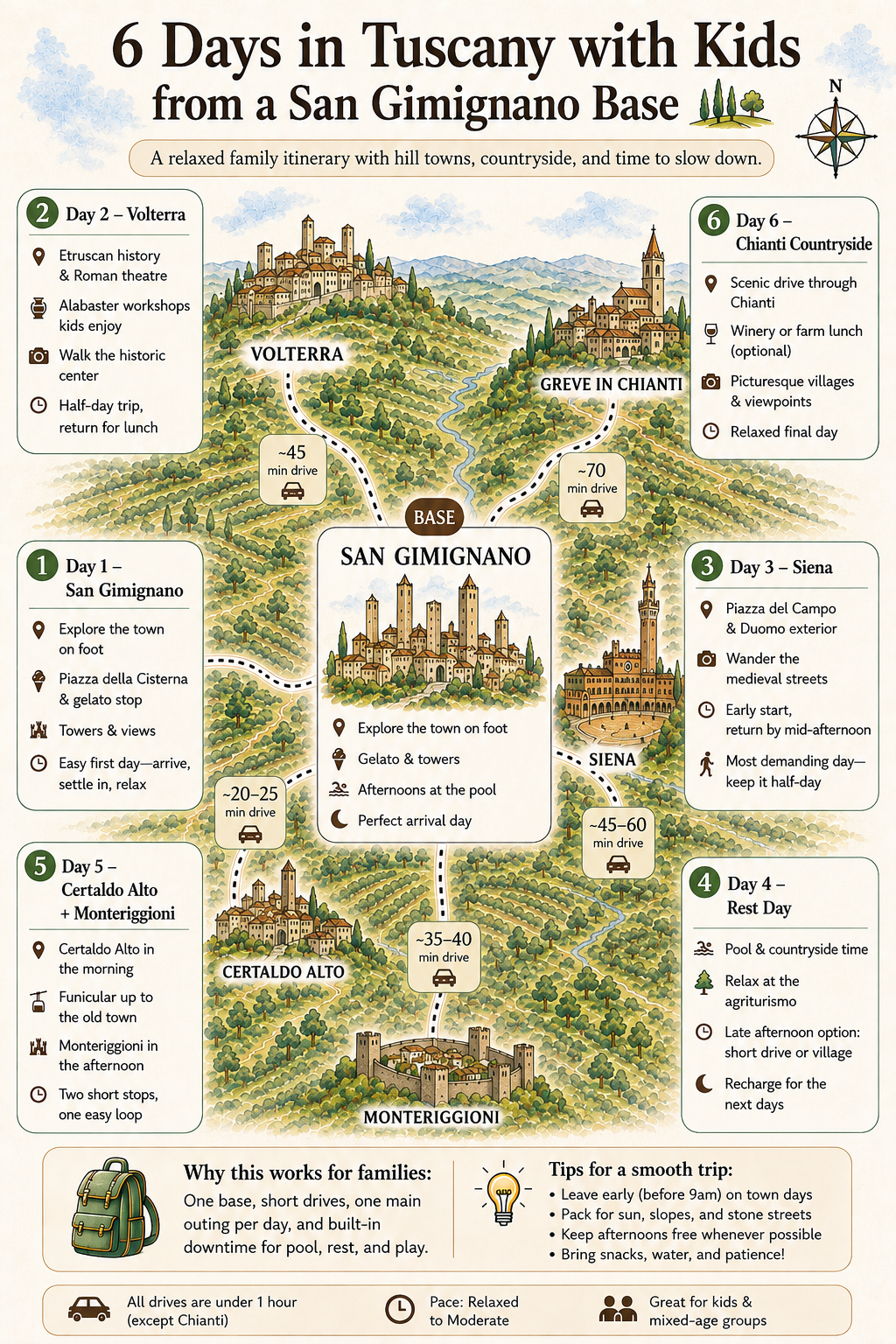
This itinerary is built for families with young children, multigenerational groups, or anyone who wants to actually enjoy Tuscany rather than survive it. It is not a highlights reel. It is a pacing-first plan built around how families actually travel.
Days 1, 4, and 6 are lighter and can absorb slow starts. Days 2 and 3 benefit from leaving before 9am. Day 5 pairs two short stops into one manageable loop.
Choosing a Base: What to Look for in a San Gimignano Agriturismo
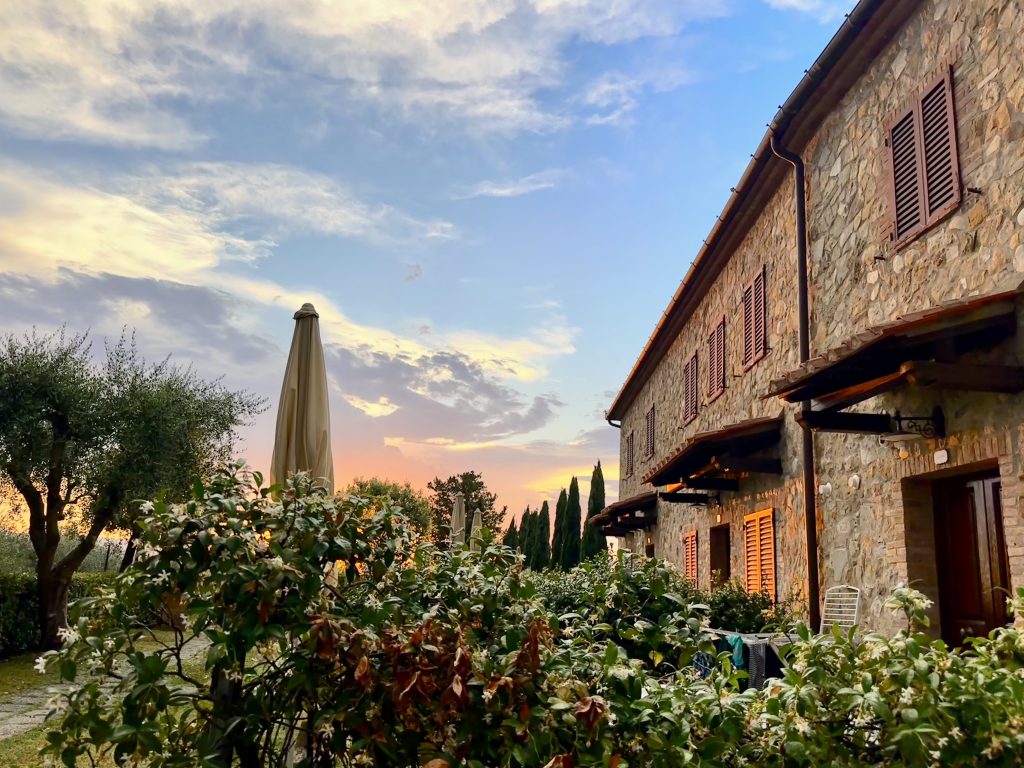
San Gimignano sits at a geographic midpoint that makes it the most practical base for this kind of itinerary. Siena is about 40 minutes south. Volterra is 45 minutes west. Certaldo is 20 minutes north. Chianti is an easy drive east. No single day requires more than an hour on the road in either direction.
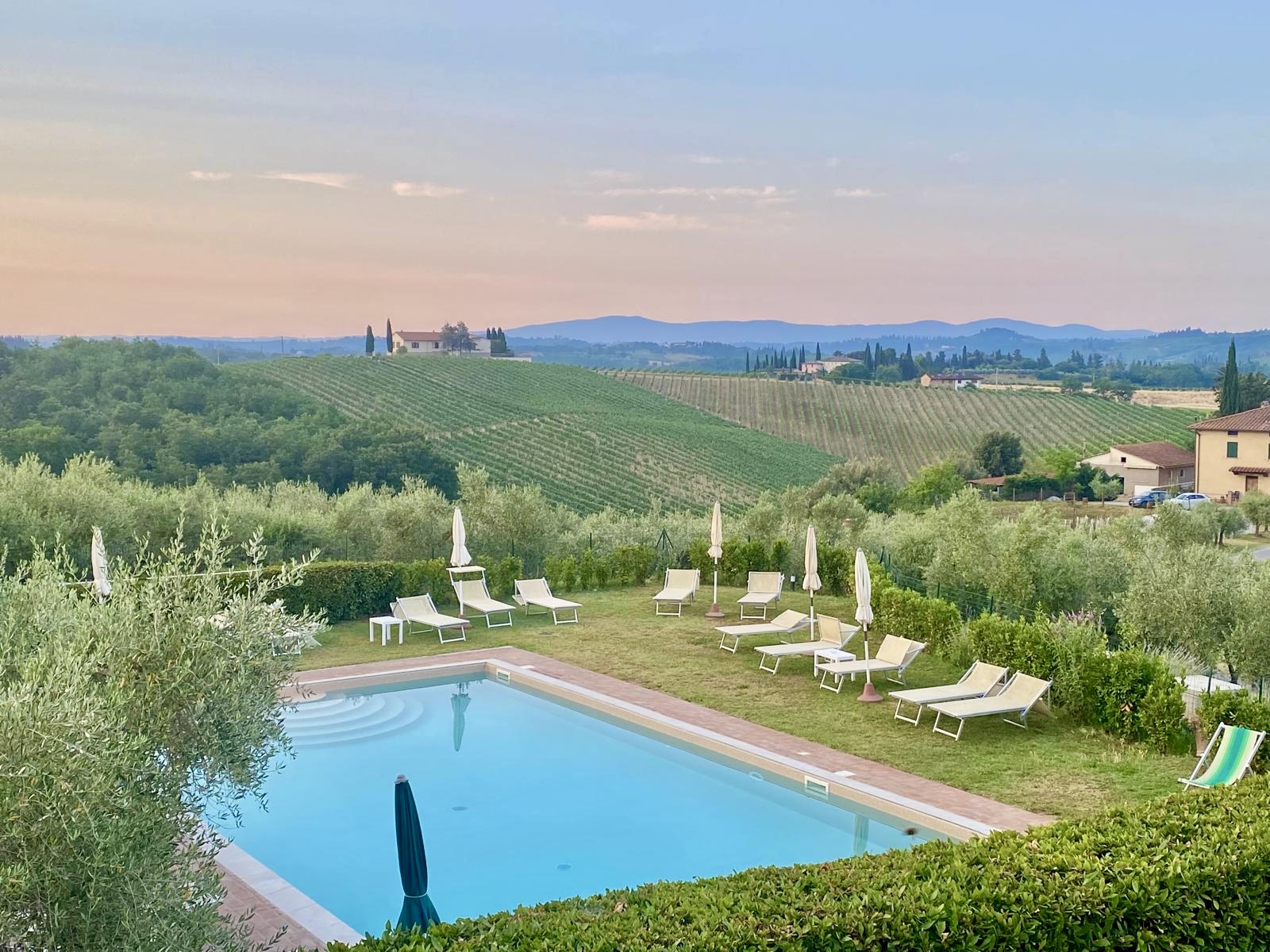
For families, an agriturismo outside the town center is usually the better choice over a hotel in San Gimignano itself. Properties in town can be compact, have limited parking, and offer little outdoor space. A working farm property a few kilometers out typically has a pool, open grounds for children to move around, and on-site dinner options that make evenings simpler.
The main tradeoff: rural agriturismi require a car for everything, including dinner out. After dark, they can feel isolated. For families, that is rarely a problem. For couples looking for nightlife, it is a different calculation.
A few things worth checking before booking:
- Pool access (ideally fenced for young children)
- Breakfast included or available on-site
- Whether the property has a kitchen or dinner service
- Wi-Fi reliability, if remote work or streaming matters
Genuine agriturismi book out months in advance for summer. Look for working farm properties rather than hotels that use the term loosely. The distinction matters both for atmosphere and for the kind of space families actually need.
Day 1: San Gimignano: Starting Close and Slow

The best move on arrival day is not driving anywhere. San Gimignano itself is the destination for Day 1, and that is by design.
Arriving, unpacking, orienting, and then walking into a medieval town fifteen minutes away is a better start than loading back into the car after a long travel day. The town is compact enough to cover in two to three hours without feeling rushed.
San Gimignano works well with kids for specific reasons. The medieval towers are visually dramatic and immediately understandable. The Piazza della Cisterna is walkable and contained. The gelato competition between local shops is a genuine draw that gives children a clear, low-stakes objective for the morning.
The main limitation: San Gimignano gets crowded by mid-morning in summer. Arriving before 9:30am or visiting in the late afternoon sidesteps the worst of it.
Keep the afternoon loose. A return to the agriturismo for pool time before dinner is not a retreat. For a family with young children, it is good planning. The trip will go better if Day 1 ends with energy left over.
Day 2: Volterra: The Day Trip Most Families Skip (and Shouldn’t)
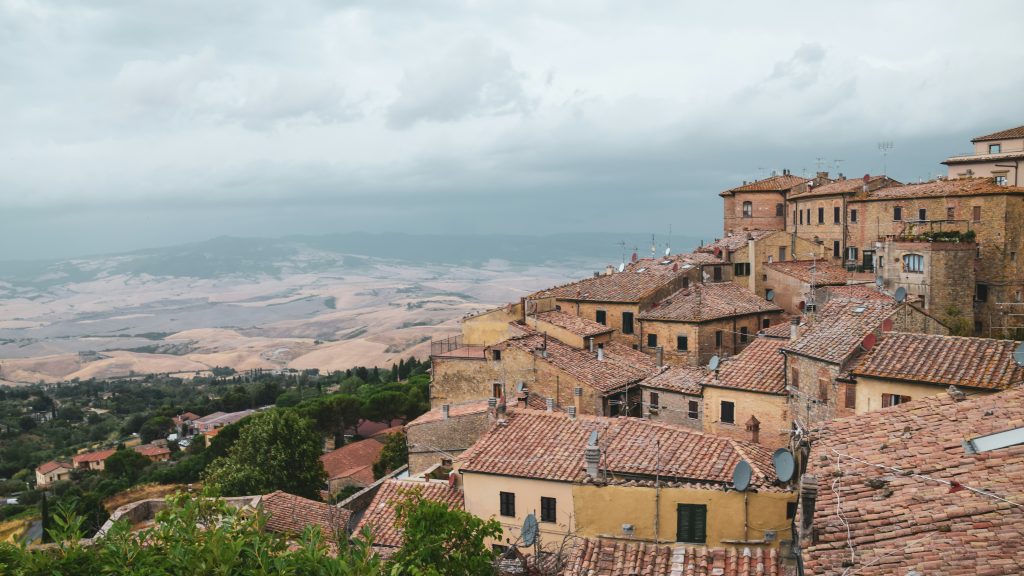
Volterra is the most underused stop on this itinerary, and it earns a place on Day 2 for a straightforward reason: it offers something different from every other Tuscan hill town on the list.
The alabaster workshops are genuinely engaging for children who have any interest in how things are made. The Etruscan museum (Museo Etrusco Guarnacci) covers one of the most accessible periods in Italian history for younger visitors. These are not church-and-piazza experiences. That distinction matters after two or three days of medieval town centers.
The Roman theatre ruins are an unexpected addition. They are visible from a public overlook without requiring tickets or entry management. For older children, the scale registers in a way that a museum exhibit often doesn’t.
Getting There
Volterra is about 45 minutes from San Gimignano. The drive involves some winding road through the countryside, which is fine for most families but worth knowing if car sickness is a factor.
What to Know Before Arriving
Parking sits below the town walls and requires a short uphill walk. It is manageable, but families with strollers or anyone with mobility concerns should plan for it. There is a shuttle bus that runs from the main parking area in high season.
The main reason to keep this day short: Volterra rewards a focused morning more than a full day. Plan for three to four hours in town, then head back for lunch and an afternoon at the pool. Trying to extend the day by adding a second stop typically works against families with young children.
Day 3: Siena: Worth the Crowds if You Plan Around Them
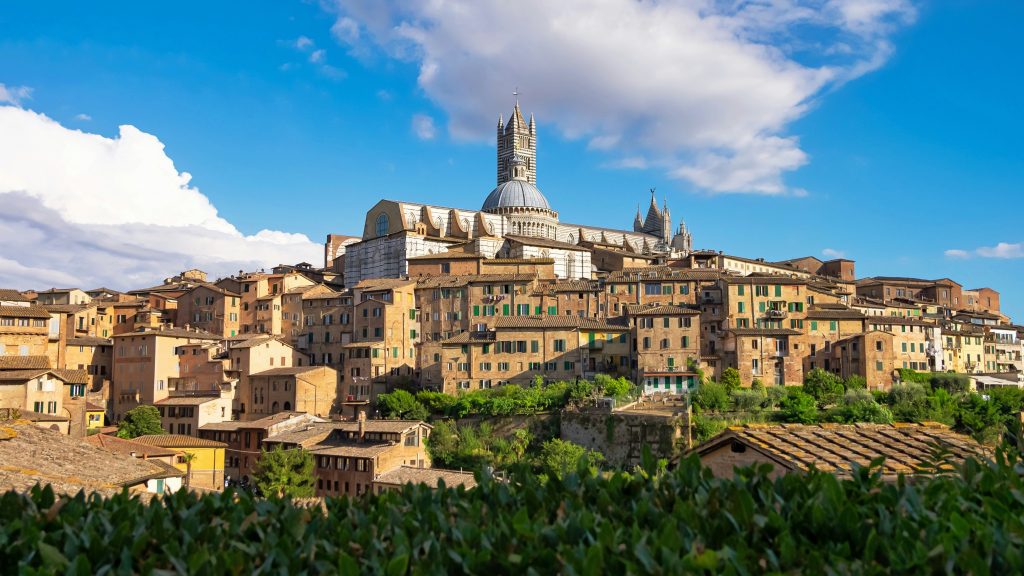
Siena is the most demanding day on this itinerary. It is larger, busier, and harder to navigate with young children than any other stop on the list. That is worth stating directly before making the case for going.
The case for going: the Piazza del Campo is one of the most impressive public spaces in Europe, and it registers even for children who have no context for it. The scale, the slope, the surrounding architecture — it works in a way that photographs do not fully convey.
What to Prioritize
Arrive before 9:30am. Walk the Campo. See the Duomo exterior. Find a café on a side street rather than facing the main square. Leave before early afternoon, when heat and crowds peak in summer.
That is a realistic half-day in Siena with kids, and it is enough.
What to Skip
The Duomo interior and the Museo dell’Opera are worth saving for a different trip unless the family has unusually strong energy that morning. Both are worthwhile sights, but they add queues, crowds, and indoor time to an already demanding day.
For most families with young children, Siena works better as a half-day built around Piazza del Campo, the Duomo exterior, a short wander through the historic center, and an early return to the agriturismo.
Day 4: A Rest Day Worth Protecting
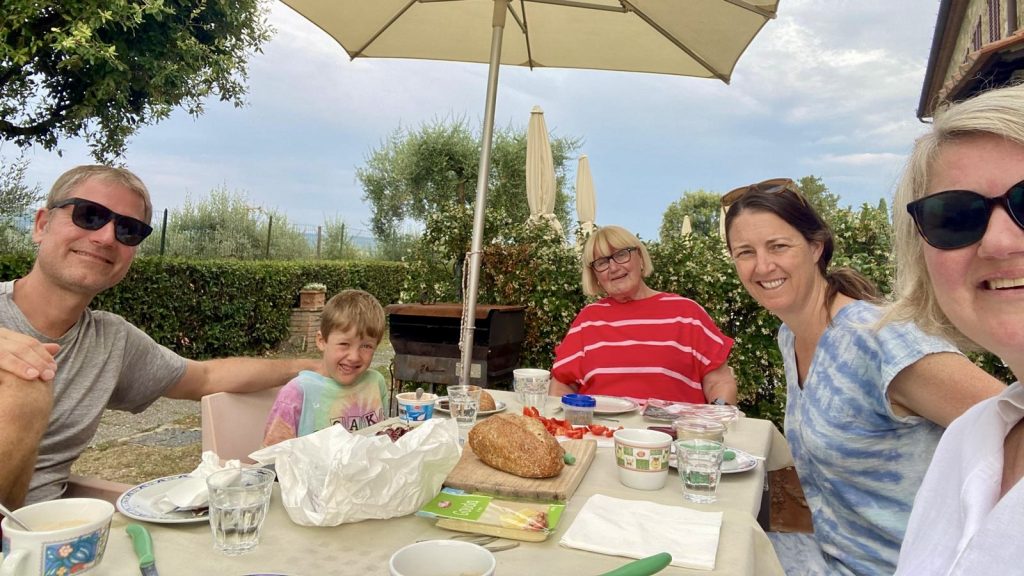
Building a non-driving day into a six-day itinerary is not a waste of a day. It is where family trips fall apart when it is not planned in advance.
By Day 4, most families with young children are running on a shorter reserve than they expected. A day without a destination protects the second half of the trip.
This day does not need a plan. Some options that work well without pressure:
- A slow morning at the agriturismo with a late breakfast
- A visit to a local market if one happens to fall on the right day
- A low-key drive through the San Gimignano countryside without a specific destination
The last option is underrated. The landscape around San Gimignano, the Val d’Elsa, and the Chianti foothills is worth seeing from a moving car with no parking obligation attached to it.
Children often remember pool days, slow lunches, and evening walks more vividly than a sixth hill town. That is not a reason to avoid sightseeing. It is a reason to plan rest deliberately.
Day 5: Certaldo Alto and Monteriggioni: Two Small Stops, One Easy Day
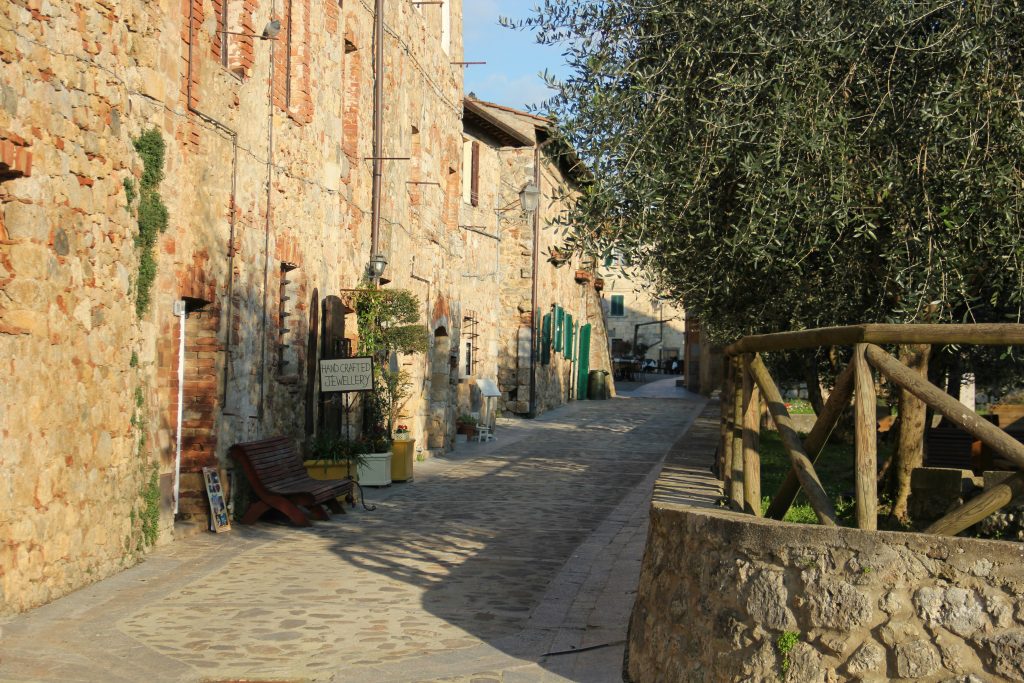
Day 5 pairs two short stops into a logical half-day loop. Neither requires more than two hours. Together, they make for a full and satisfying day without the pressure of a major sight.
Certaldo Alto is a small, walled medieval town that most tourists bypass entirely. That is its main advantage. The funicular that connects the lower town to the upper section is a practical draw for children and a welcome alternative to climbing a steep medieval street with a stroller or tired legs.
Monteriggioni is a complete medieval walled village that takes less than an hour to walk in full. It is easy for all ages, offers good sightlines from the walls, and does not require much planning or advance booking.
Suggested Sequence
Certaldo Alto in the morning, when it is quietest. Lunch back near the agriturismo or in San Gimignano. Monteriggioni in the late afternoon, when the light is better and crowd levels drop.
This day works particularly well following a rest day. It is lighter and more exploratory, without the logistical demands of Volterra or Siena. It is also a good day to adjust or abbreviate if the trip needs more breathing room.
Day 6: Chianti Countryside: The Drive Is the Point
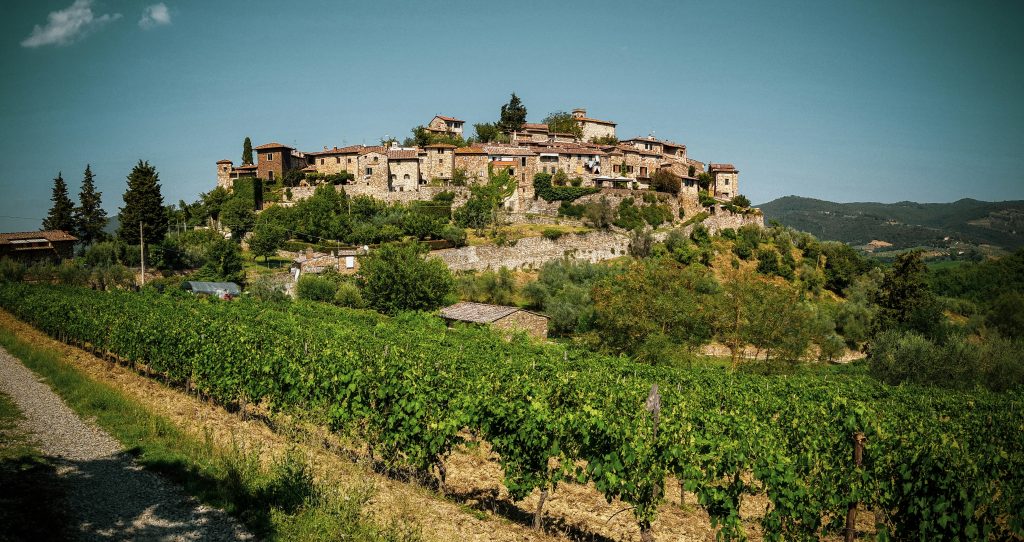
Day 6 is not a sightseeing day in the conventional sense. It is a decompression day with scenic purpose, and it rounds out the itinerary without adding a new major destination.
The drive through Chianti between Greve in Chianti and Gaiole in Chianti is worth doing slowly. The road conditions are good. The countryside drive is the main reason to go.
Greve in Chianti makes a practical stopping point. The main square has a morning market atmosphere, there are good options for a relaxed lunch, and the scale is manageable. Plan to spend two to three hours there without feeling obligated to fill the afternoon.
A practical note for adults traveling with children: many Chianti wineries do not actively cater to families. Drop-in visits with young children can be awkward if a property is not set up for it. If wine purchases are a goal, a shop in Greve in Chianti or a direct purchase from a producer that welcomes families is a more reliable approach than a full winery tour with children in tow.
Close Day 6 early. Dinner on-site at the agriturismo, some time for packing, and a slower last evening is the right ending for this kind of trip. An exhausted scramble on the final night undercuts everything that came before it.
Making It Work: Practical Notes for Families Planning This Trip
Car Rental
A car is non-negotiable for this itinerary. There is no practical train-based version of this route that works for families with young children. Car seat logistics should be confirmed before arrival — rental companies in Italy carry them, but availability is not guaranteed without advance booking.
Tuscan rural roads are generally in good condition. Some approach roads to agriturismi are unpaved for the last kilometer or two. A standard vehicle handles them fine. A very low-clearance car may require more caution.
Best Time of Year
Late May, early June, and September hit the practical sweet spot for Tuscany with kids. Heat is manageable, crowds are below peak levels, and the landscape is at its best. July and August are viable but require earlier starts, more patience with crowds, and more attention to midday heat management.
Booking the Agriturismo
Genuine agriturismi with pool access and family-suitable space book out months in advance for July and August. Targeting late May or September opens more options and typically reduces both price and crowd pressure. Look for properties that explicitly list family amenities rather than assuming the category includes them.
Managing Expectations with Kids
Tuscany rewards slow observation more than activity-based entertainment. Families who frame the trip as immersive rather than stimulating tend to come away happier. The pace of medieval towns, long lunches, and countryside drives is well-suited to children who do reasonably well with slower meals, short walks, and unstructured pool time. It is less well-suited to children who need structured activity every few hours.
Traveling With Mixed Ages
This itinerary also works well for groups with mixed ages because it avoids hotel changes and keeps most outings short. The main thing to watch is walking terrain. San Gimignano, Volterra, Siena, and Certaldo Alto all involve stone streets, slopes, and some uneven surfaces. Comfortable shoes matter more than packing extra activities.
For older travelers or anyone with limited stamina, the best strategy is to treat each day as one main outing followed by a real return to the agriturismo. Tuscany is more enjoyable when the afternoon is not treated as a second sightseeing shift.
When to Skip a Stop
If the trip is not clicking by Day 3, Volterra or Certaldo Alto can be dropped without breaking the itinerary. The plan works with five stops and one extra rest day. The single-base format means that a change of plan costs nothing in logistics.
What This Itinerary Intentionally Skips
This itinerary does not include Florence, Pisa, Lucca, or the Val d’Orcia. Those places are worthwhile, but they do not fit the pacing of a six-day San Gimignano-based family itinerary as cleanly as closer stops.
Florence works better as its own city stay. Pisa and Lucca pair well from the northwest side of Tuscany. The Val d’Orcia is better from a southern base such as Pienza, Montepulciano, or Montalcino.
Skipping them is not a weakness of the route. It is what keeps the itinerary realistic.
The Trip Families Actually Remember
The value of a single-base approach to Tuscany with kids is not convenience alone. It changes the texture of the trip.
A Tuscan trip built around rhythm rather than logistics tends to hold up better in memory than one built around ticking off every landmark. The slower-paced version of Tuscany with kids is not the compromise version. For most families, it is the better version.
The planning decisions that matter most for this itinerary — where to stay, how many stops per day, whether to protect a rest day — are all made before arriving. Getting those decisions right is what makes the difference between a trip that works and one that wears everyone out.