What to See (and Skip) in Rome in 4 Days with Kids
Rome with young children is very doable, but it requires a different plan. This 4-day Rome itinerary focuses on what to see and what to skip when traveling with kids aged 5–7, prioritizing a few major sights each day and avoiding the long queues, midday heat, and overpacked schedules that tend to derail family trips.
The structure is simple: four days based in Trastevere, front-loaded with the most demanding sights while energy is highest, then easing into slower, neighborhood-based days. Not every monument makes the list. That is intentional.
This plan works best when the arrival day is treated lightly. Use it for checking in, getting oriented, buying snacks or breakfast basics, and taking a short walk through Trastevere. The four itinerary days below assume the family is ready to start sightseeing the next morning.
The goal is not to finish Rome. The goal is to leave with a few strong memories instead of four exhausted days.
The 4-Day Rome Plan at a Glance
| Day | Area Focus | Anchor Sight | Pace |
|---|---|---|---|
| 1 | Ancient Rome | Colosseum + Roman Forum | Moderate |
| 2 | Vatican area | Vatican Museums + St. Peter’s Basilica | Heavy |
| 3 | Central Rome | Piazza Navona + Pantheon | Easy |
| 4 | Trastevere + Gianicolo | Neighborhood exploration | Relaxed |
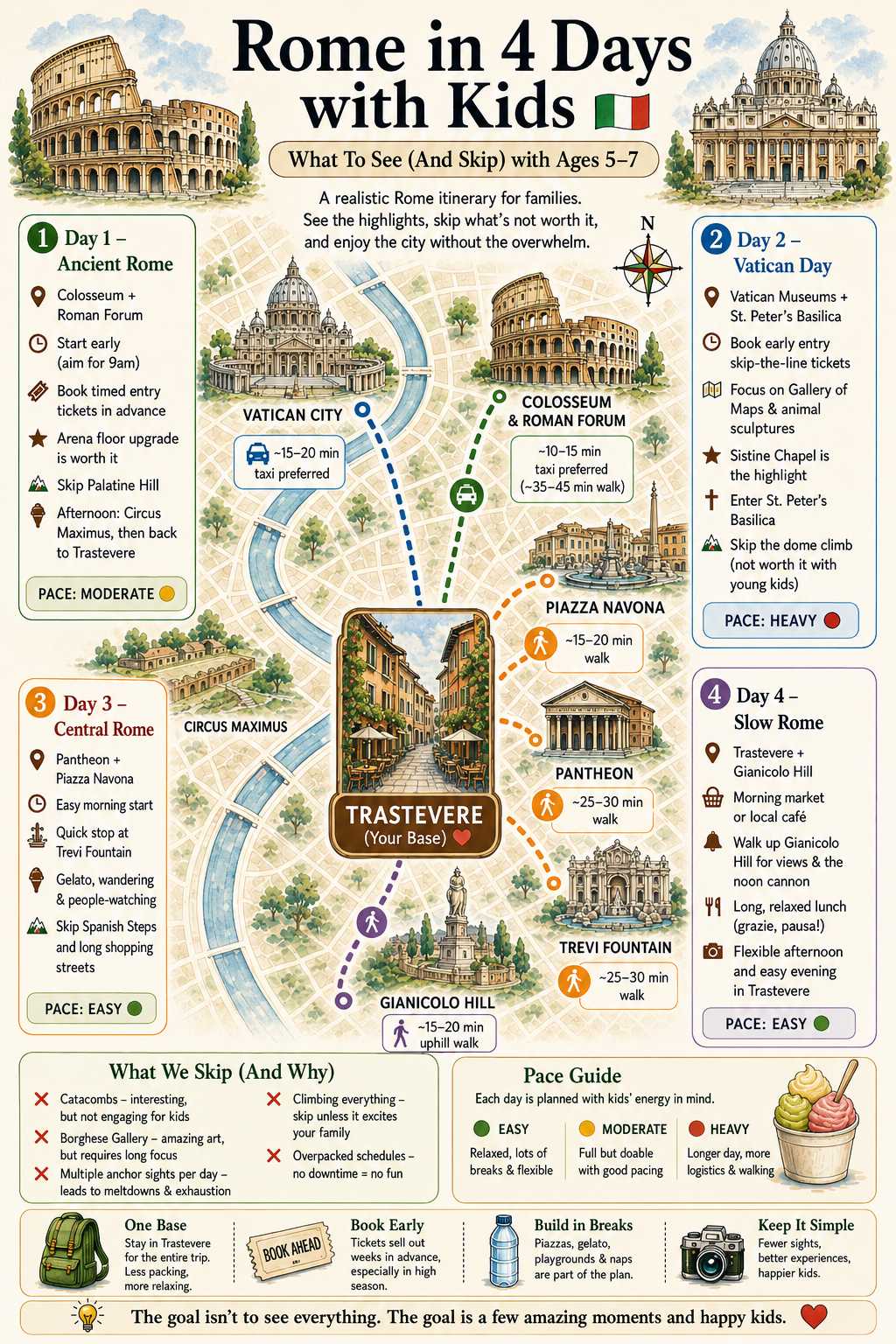
Days are intentionally front-loaded. Day 2 is the most logistically complex. Day 4 is the most flexible and, for many families, the most rewarding.
Trastevere works as a base because it is central without being in the thick of tourist traffic. The streets are walkable, restaurants are informal, and the neighborhood is quieter in the evenings than the Historic Centre.
Where to Stay: Why Trastevere Makes Sense for Families
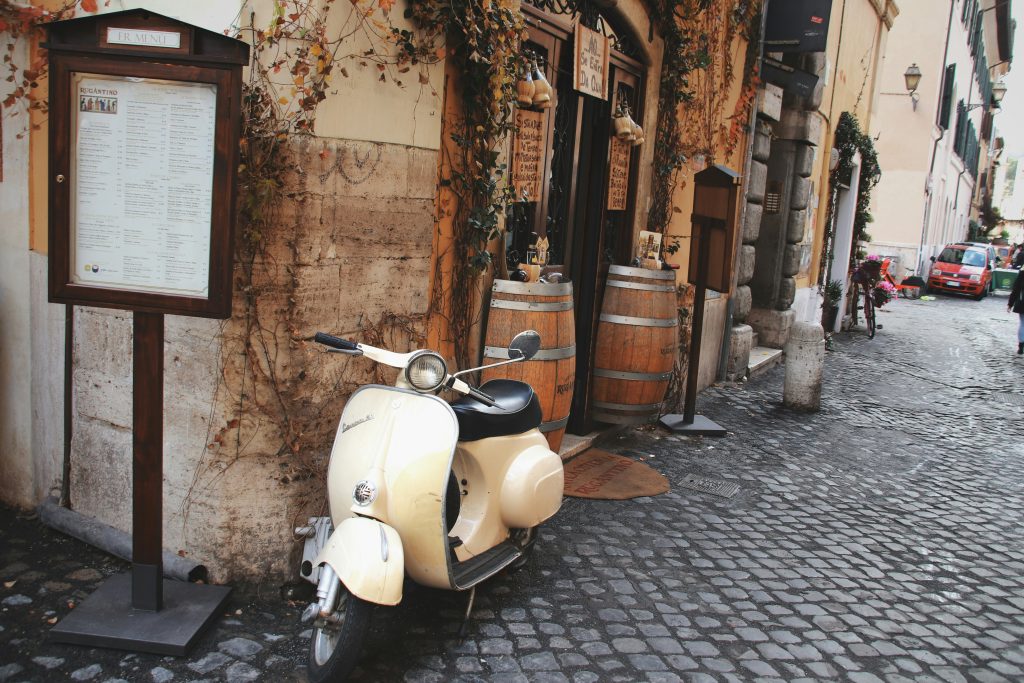
Trastevere is a practical family base, not just a scenic one. The cobblestone streets are manageable, the restaurant culture is relaxed and unpretentious, and the tourist density is noticeably lower than around the Pantheon or Piazza Navona.
The neighborhood sits within walking distance of the Roman Forum and Circus Maximus, and is a short taxi or bus ride from the Vatican area and central piazzas.
When selecting accommodation, look for ground-floor access or a building with an elevator, proximity to a small market or bakery, and outdoor space if possible. Apartment rentals work well for this age group.
The main limitation is Vatican proximity. Trastevere is not the most convenient base for early Vatican mornings, so factor in a 15–20 minute commute on Day 2.
To make the first few days easier, use the interactive Rome map below that highlights practical stops. It includes accommodations, cafés, restaurants, cultural sites, public toilets, parks, and useful transportation points.
Day 1 — The Ancient City: Colosseum, Forum, and Knowing When to Stop

Colosseum: What to Book and What to Expect
The logistics case for doing this first is straightforward. Pre-book timed entry tickets well in advance and aim for a 9am slot before heat and crowds build. In peak months (April–October), same-day tickets are rarely available.
At the Colosseum, the arena floor level is visually striking and worth the upgrade. Children respond well to the scale of the space and the open-air exposure. The upper levels can be steep and narrow, and they usually offer less payoff for this age group. The tradeoff is clear: spend more time on the arena floor experience and less time climbing.
Roman Forum: Short Loop, Not Full Coverage
The Roman Forum is large and abstract. Families can do a short loop of 30–40 minutes without feeling obligated to cover every section. Most of it reads as scattered stonework to a six-year-old, and that’s not a failure of the visit — it’s a realistic assessment of what the site offers this audience.
Palatine Hill is the easiest part of the Ancient Rome ticket to skip on this itinerary. It adds significant walking time and has minimal narrative payoff for young children. For families with limited energy reserves, saving those steps matters.
Circus Maximus works well as an end to the afternoon. It is open, flat, low-key, and easier to explain to children than the Forum — a large track where chariot races happened is a concept that lands.
Return to Trastevere for lunch, downtime, and an evening passeggiata rather than adding a second anchor sight. One major site per day is the right ceiling for this age group.
Day 2 — The Vatican: What to Book, What to Skip, and Managing the Visit
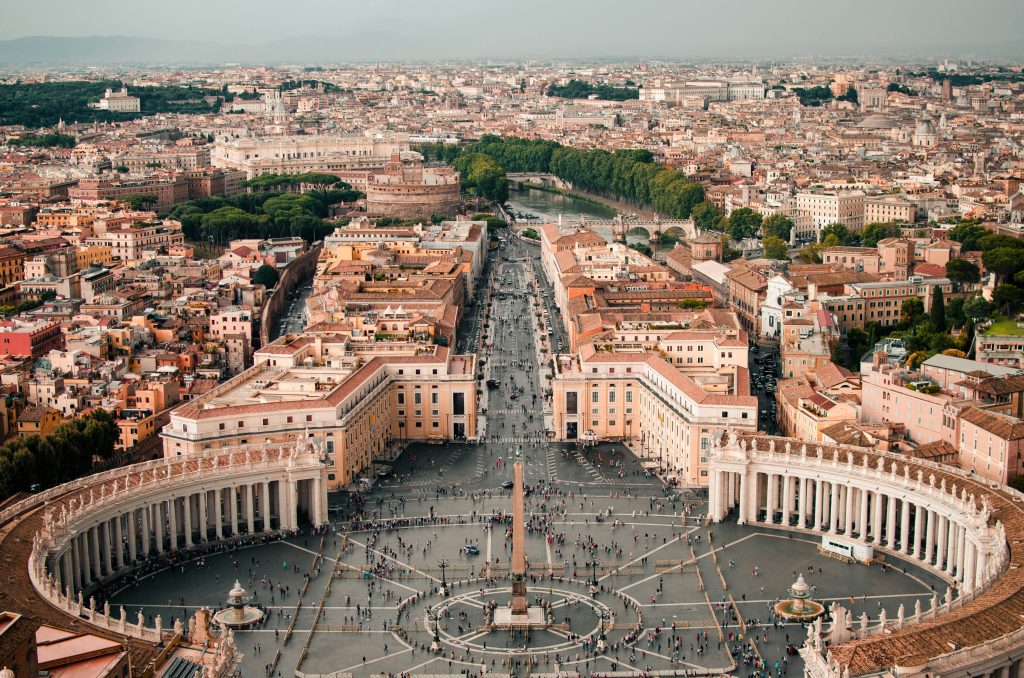
Day 2 is the most logistically demanding day on this itinerary and the one that most often breaks family trips. Address it early, with a plan, and with realistic expectations about duration.
Vatican Museums: Priority Routing
Book skip-the-line tickets with early entry. The first slot of the day is significantly less crowded, and the difference between arriving at 8am and 10am is measurable in both queue length and atmosphere.
The walk through the Vatican Museums to reach the Sistine Chapel is long. Plan for 2–2.5 hours minimum just to cover the Sistine Chapel sequence. That is before any additional galleries.
For families with young children, the priority routing through the Vatican Museums should focus on the Gallery of Maps and the animal sculptures in the Pio-Clementino museum. Both hold children’s attention better than the extensive painting galleries, which are better suited to older visitors with art history context.
The Sistine Chapel is the payoff. The ceiling is immediately comprehensible even to young children — a large painted room with a famous scene. That directness helps.
St. Peter’s Basilica
St. Peter’s Basilica is worth entering. The vast interior scale impresses children in a way that artifacts and paintings often don’t. Skip the dome climb with this age group — it is steep, enclosed, and tiring, and the view does not justify the effort at this age.
If timing allows, returning to St. Peter’s Square at dusk is preferable to midday. It is quieter and the light conditions are better.
One practical note: Food inside the Vatican complex is limited and often overpriced. Eat breakfast before arriving and exit the museum area for lunch.
Day 3 — Rome’s Piazzas and the Pantheon: A Gentler Day
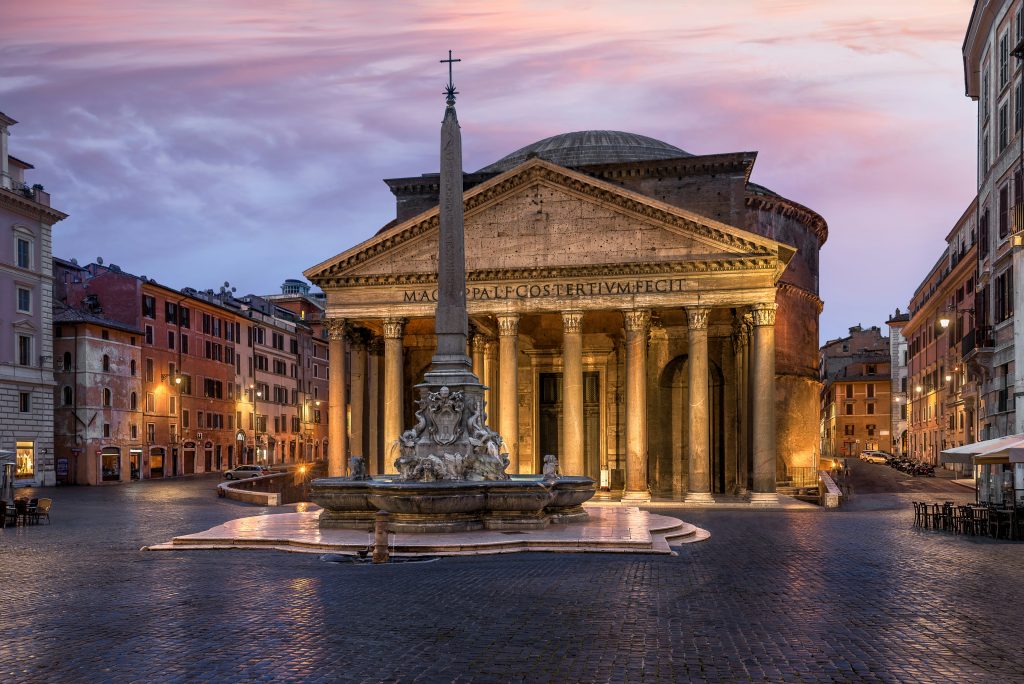
Day 3 is designed to decompress after the Vatican. Fewer queues, more wandering, more gelato. This is the most flexible day in the Rome itinerary and the one where children typically set the pace.
Piazza Navona works well as a morning stop. The Fountain of the Four Rivers is visually engaging for children, the surrounding cafes support a slow breakfast, and the square is walkable from Trastevere via Campo de’ Fiori.
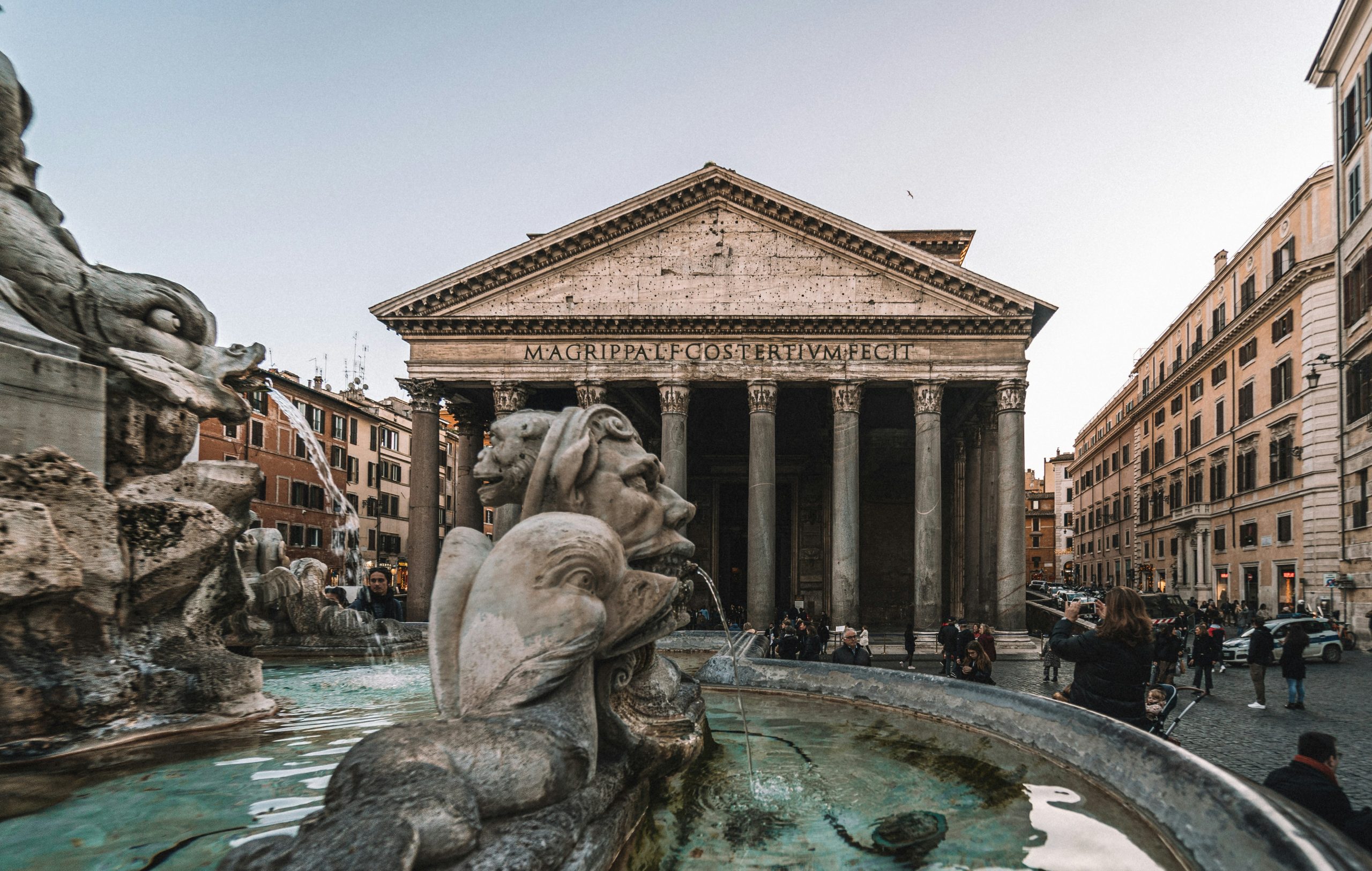
The Pantheon now requires a timed entry ticket — book in advance. The visit itself is short (30–45 minutes), but it is one of Rome’s most child-accessible sights. The oculus is immediately visible, immediately explainable, and genuinely striking. Children understand a hole in the ceiling letting in light and rain in a way that requires no art history background.
The Trevi Fountain should be included but with calibrated expectations. It will be crowded at almost any hour. Treat it as a quick stop rather than a lingering experience, and visit mid-morning rather than midday when crowds peak.
For the afternoon, the grounds of Villa Borghese (not the gallery) offer good open space, shade, and room to move without a ticket. Alternatively, letting children lead through a market near Campo de’ Fiori or a small shop is a low-effort way to fill the afternoon.
Skip the Spanish Steps on this trip. They are photogenic but add distance and offer little for young children beyond the climb itself.
Day 4 — Staying Close: Trastevere and the Gianicolo Hill
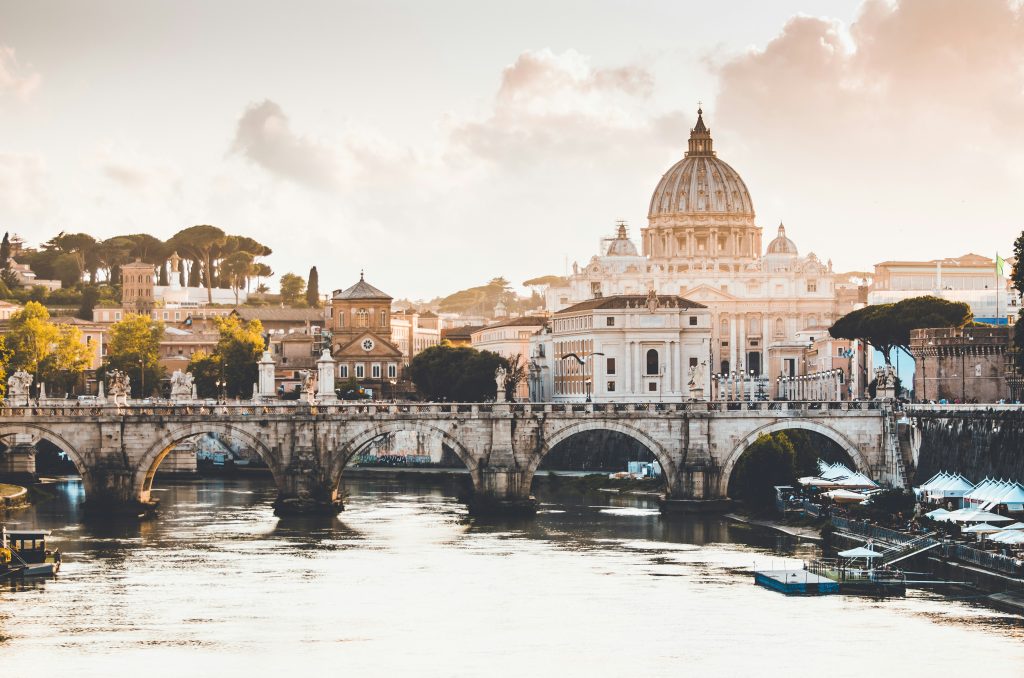
Day 4 is the day most families underestimate. Staying local often produces some of the strongest memories of a Rome trip, particularly for young children who respond to texture and routine more than scheduled sights.
Start with a morning walk through Trastevere before the neighborhood fills up. The market at Piazza di San Cosimato is worth a stop for fruit, pastries, and a sense of how the neighborhood functions in the morning.
Gianicolo Hill is accessible by a short uphill walk or taxi. The panoramic view of Rome from the terrace is one of the best in the city and requires no ticket, no queue, and no preparation. For families, the cannon fired at noon daily is a small but reliably memorable moment for children.
The afternoon works well as a return visit to a favorite spot from earlier in the trip — the Roman Forum viewed from a distance, a specific church, or simply a piazza with good people-watching and a willingness to sit.
Close with dinner in Trastevere itself. The restaurants are informal enough for children, early enough for a family schedule, and followed naturally by an evening walk through the neighborhood streets.
What to Skip (or Shorten) in Rome with Young Kids
Skipping something is not a failure — it is a sign of a realistic itinerary. These are the sites most commonly over-planned for families with children aged 5–7.
- Borghese Gallery: An extraordinary museum, but it requires advance tickets, operates on a strict 2-hour timed entry window, and is weighted heavily toward painting and sculpture that skews adult. Not the right fit for this age group.
- Catacombs: Logistically interesting for adults, but the enclosed underground spaces and subject matter can be genuinely distressing for young children. Best saved for a future trip.
- Ostia Antica: A genuinely excellent Roman site — arguably more manageable than the Roman Forum — but it requires a 30-minute train journey each way. On a 4-day trip, that travel overhead is hard to justify.
- Over-scheduled mornings: The most common structural mistake families make in Rome. Building in 30–45 minutes of unstructured time at the start of each day improves the overall experience measurably. Rome does not reward rushing.
Practical Notes: Tickets, Timing, Food, and Getting Around
- Tickets: The Colosseum, Vatican Museums, and Pantheon all require advance booking. Same-day availability is unreliable from April through October. Book as early as possible, especially for Vatican Museums first-entry slots.
- Timing: Aim to start anchor sights by 9am. In July and August, build in a structured rest period between 1–3pm to avoid midday heat. With young children, this rest period is often what keeps the rest of the day workable.
- Food: Trastevere has a strong concentration of family-appropriate restaurants. Look for places without tourist menus posted outside. Pizza al taglio (by the slice) is fast, inexpensive, and consistently accepted by children.
- Getting around: The historic center is largely walkable from Trastevere. Taxis are preferable to the metro for families with young children, given the number of stairs and the distances between metro stops and major sights.
- Strollers: The cobblestones in Trastevere are manageable but uneven. A lightweight umbrella stroller works. Larger strollers create problems at most entrance queues and are not worth bringing.
The Case for Going Slowly
A successful family trip to Rome is not a checklist of monuments. It is a handful of moments that actually land — the Colosseum arena floor, the Sistine Chapel ceiling, the oculus light moving across the Pantheon floor at midday, the Gianicolo cannon at noon, gelato eaten standing up on the walk home.
This Rome itinerary leaves real gaps on purpose. Time to get lost. Time for a second scoop. Time to sit in a piazza and watch the city move. Children remember the texture of a trip more than the specific sights, and Rome at a slow pace gives them the texture.
Four days, done this way, is enough. There will be things left unseen. That is the correct outcome for a trip that works.